
Microsoft Azure outages and problems
User reports, last 24 hours
211 reports in total, counted in 15-minute windows
In the last hour, 14 problem reports came in for Microsoft Azure, against about 24 at this time on a usual day. Over the last 24 hours there were 211 reports. Worldwide, most recent reports were about server connection (36%) and virtual machines (25%). The last spike in reports was 27 h ago and lasted 39 min. These are user reports from the US, where most people report Microsoft Azure problems.
Around the world right now: normal in 71 other countries. Most reports in the last hour: Brazil 4 · Poland 3 · the UK 1. By country
- NormalClose to the usual level24 h · 211 reports
- ElevatedMore than 1.5 times the usual levelNone in this chart
- OutageMore than twice the usual level and far above the day's averageNone in this chart
- Usual levelWhat a usual day sees at that timeAbout 24 an hour now
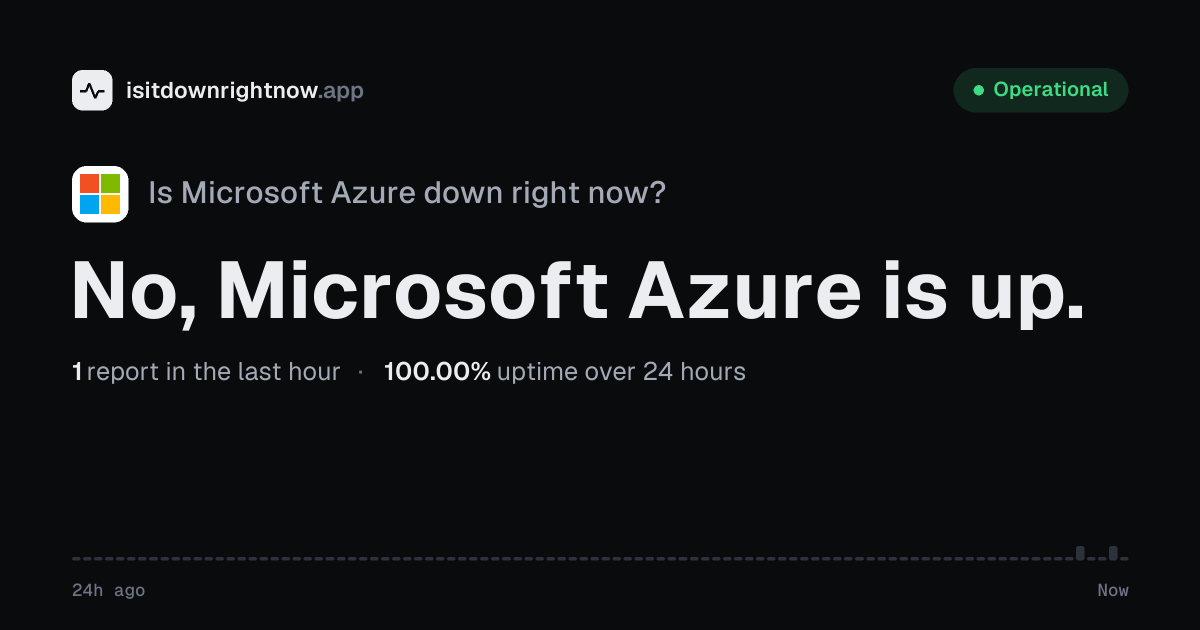
In the past 24 hours, 211 user reports came in for Microsoft Azure. Counting only the 15-minute windows with a spike big enough to count as an outage, that comes to 100.00% uptime for the day.
The busiest 15-minute window had 9 reports, about 23 hours ago. That stays below our outage threshold, so it doesn't count as downtime.
Microsoft Azure in November 2026
- Problem reports in November
- 1,783
- Outage spikes
- 2
- Periods of elevated reports
- 6
Monthly report for November 2026
What went wrong
What people said was wrong in recent problem reports for Microsoft Azure worldwide.
Share of 36 recent reports that said what was wrong, from every country listed below.
Microsoft Azure reports around the world
In the last 24 hours, 747 problem reports about Microsoft Azure came in from 39 countries. Right now reports are at the usual level in every country.
- Outage now
- Problems now
- Normal
| Country | Now | Last hour | 24 hours |
|---|---|---|---|
| The US numbers above | Normal | 4 | 258 |
| Brazil | Normal | 4 | 73 |
| Poland | Normal | 3 | 24 |
| The UK | Normal | 1 | 190 |
| Japan | Normal | 1 | 30 |
| The Netherlands | Normal | 1 | 21 |
| Canada | Normal | 1 | 14 |
| Portugal | Normal | 1 | 11 |
| Italy | Normal | 1 | 9 |
| Norway | Normal | 1 | 8 |
| Finland | Normal | 1 | 5 |
| Sweden | Normal | 1 | 4 |
Each country's status compares its reports with the usual level there. 60 more countries had 100 reports in the last 24 hours. Map outlines: Natural Earth.
Microsoft Azure problem spikes, last 30 days
In the last 30 days, Microsoft Azure had 5 outage spikes and 15 periods of elevated reports. The longest lasted 1 h 39 min, on 28 October.
- Mon 12 Oct: 2 reports
- Tue 13 Oct: 14 reports
- Wed 14 Oct: 4 reports
- Thu 15 Oct: 10 reports
- Fri 16 Oct: 1 report
- Sat 17 Oct: 2 reports
- Sun 18 Oct: 0 reports
- Mon 19 Oct: 8 reports
- Tue 20 Oct: 6 reports
- Wed 21 Oct: no data
- Thu 22 Oct: 0 reports
- Fri 23 Oct: 5 reports
- Sat 24 Oct: 0 reports
- Sun 25 Oct: 0 reports
- Mon 26 Oct: 5 reports
- Tue 27 Oct: 25 reports (outage spike that day)
- Wed 28 Oct: 177 reports (outage spike that day)
- Thu 29 Oct: 329 reports (elevated reports that day)
- Fri 30 Oct: 322 reports (outage spike that day)
- Sat 31 Oct: 49 reports
- Sun 1 Nov: 36 reports
- Mon 2 Nov: 264 reports (elevated reports that day)
- Tue 3 Nov: 350 reports (outage spike that day)
- Wed 4 Nov: 271 reports (elevated reports that day)
- Thu 5 Nov: 205 reports
- Fri 6 Nov: 203 reports
- Sat 7 Nov: 34 reports
- Sun 8 Nov: 25 reports
- Mon 9 Nov: 252 reports (outage spike that day)
- Tue 10 Nov: 143 reports
-
Outage
Mon 9 Nov, 16:22–17:01Lasted 39 min32peak reports
-
Elevated reports
Wed 4 Nov, 21:25–21:45Lasted 21 min13peak reports
-
Elevated reports
Wed 4 Nov, 17:03–17:30Lasted 27 min19peak reports
-
Elevated reports
Tue 3 Nov, 22:20–22:46Lasted 26 min13peak reports
-
Elevated reports
Tue 3 Nov, 21:34–21:55Lasted 21 min13peak reports
-
Outage
Tue 3 Nov, 18:33–19:03Lasted 30 min22peak reports
-
Elevated reports
Tue 3 Nov, 15:39–16:24Lasted 45 min19peak reports
-
Elevated reports
Mon 2 Nov, 22:02–22:53Lasted 51 min12peak reports
12 earlier spikes in this period.
By country
Each square is one day in the countries with the most reports: red when reports stayed at outage level for half an hour or more, amber when they stayed above the usual level for an hour or more, grey otherwise.
- Brazil3,180
- The US2,368
- The UK826
- Japan351
- The Netherlands230
- India212
- Poland177
- Germany155
Country history starts on 29 October 2026. Days run from midnight to midnight, Central European time.
A spike is a sharp rise in problem reports from users, kept exactly as this page showed it at the time. Monthly reports for all services
How to fix Microsoft Azure not working
Microsoft Azure is up on our end, so if it won't work for you, the problem is most likely on your side. Work through these in order:
Your browser tries to reach azure.microsoft.com over your own connection, right now. Nothing is sent to us or stored.
Open Service Health in the Azure portal
Start with Service Health. Type Service Health in the top search bar of the Azure portal and open Resource health to see if your region or subscription has a known outage.
Switch Azure directories after a full sign out
You may sit in the wrong tenant. Click your profile icon in the top right of the portal and choose Switch directory, because your login can stick to a tenant without access to the subscription you need.
Reload the Azure portal in an InPrivate window
A stuck blade often means local cache. Press Ctrl Shift Delete in Edge or Chrome, clear cached images for the last day, then you open an InPrivate window and sign in again to reload the portal shell.
Check Resource Health and restart the VM
If the portal loads but the VM hangs. Open the VM in the portal, select Resource health under Help in the left menu, read the status, and use Restart at the top when it points to a platform fault you cannot clear with a fresh login.
While Microsoft Azure is down: what to use instead
- Azure CLI or PowerShell When the portal hangs on a blank blade or keeps spinning, the az command line and Azure PowerShell talk to the management API directly, so you can often still restart, scale or inspect resources from a terminal.
- A paired region If you set up geo-replication, fail over to your secondary region.
- AWS or Google Cloud For a static site or a small stateless app, you can push a copy to another cloud and point DNS at it until things recover, and a low TTL on that record makes the switch much faster.
- The Azure mobile app On iOS or Android it lets you check resource health and restart a VM when the browser portal won't load.
Fix Microsoft Azure on Windows, Mac, Android and iPhone
Microsoft Azure on Windows
- Fix
- Clear your web browser's cache and cookies, or disable any active VPNs and proxies that might block the Microsoft Azure portal. If using Azure CLI or PowerShell, ensure your network allows traffic to Azure management endpoints.
- Check
- Attempt to sign in to the Microsoft Azure Portal via a web browser or check the official Azure Status page for ongoing regional outages.
ping azure.microsoft.comTest whether Microsoft Azure's servers replynslookup azure.microsoft.comCheck that Microsoft Azure's DNS resolvestracert azure.microsoft.comTrace where the connection dropsipconfig /flushdnsClear the DNS cache, then reloadMicrosoft Azure on Mac
- Fix
- Clear your browser cache, try accessing the Microsoft Azure portal in an incognito window, or temporarily disable your firewall. Ensure your Mac's keychain credentials for Azure CLI are not corrupted.
- Check
- Try loading the Microsoft Azure portal in Safari or Chrome, or run a basic network diagnostic to Azure's endpoints.
ping -c 4 azure.microsoft.comTest whether Microsoft Azure's servers replynslookup azure.microsoft.comCheck that Microsoft Azure's DNS resolvestraceroute azure.microsoft.comTrace where the connection dropssudo dscacheutil -flushcache; sudo killall -HUP mDNSResponderFlush the macOS DNS cache, then reloadMicrosoft Azure on Android
- Fix
- Force close the Microsoft Azure app, clear its cache in your device settings, and check for updates in the Google Play Store. Switching from Wi-Fi to mobile data can also resolve local connection issues.
- Check
- Open the Microsoft Azure app to see if it loads your resources or displays a connection error. You can also check the Azure Status website using a mobile browser.
Microsoft Azure on iPhone and iPad
- Fix
- Restart the Microsoft Azure app, or reinstall it from the App Store to clear corrupt local data. Ensure that cellular data is enabled for the app and disable any active VPNs in your iOS settings.
- Check
- Launch the Microsoft Azure app to check if you can access your dashboard. If it fails to load, check the Azure Status page in Safari to see if there is a global service outage.
Biggest Microsoft Azure problems so far
-
1
OutageLasted 39 min32reports in 15 min
-
2
OutageLasted 1 h 39 min28reports in 15 min
-
3
OutageLasted 1 h23reports in 15 min
Ranked by the most problem reports in one 15-minute window. Our archive started on 5 October 2026, so earlier problems are not counted. Times are Central European time.
Problems at the same time as Microsoft Azure
In the last 30 days, all 20 of Microsoft Azure's spikes in problem reports overlapped a spike at another service.
When several services get problem reports at once, something they share, such as a cloud host or a network, can be the real cause. Matching times alone do not prove it.
Most often at the same time
- ADP18 times
- Starbucks16 times
- USPS16 times
- Archive of Our Own14 times
- Straight Talk13 times
- Microsoft 36512 times
How many of Microsoft Azure's spikes overlapped one of theirs.
During the latest spike
Microsoft Azure: Mon 9 Nov, 16:22 to 17:01
- Lloyds Bank, outage,09:52 to 21:43
- Discord, outage,12:19 to 19:29
- X (Twitter), outage,12:25 to 17:59
- Sunrise, outage,13:05 to 17:07
- Bank of America, outage,13:22 to 10 Nov 03:35
- Cloudflare, outage,13:39 to 21:31
- Fortnite, outage,14:24 to 19:11
- Epic Games Store, outage,14:35 to 18:31
96 more services. Red dot: outage. Amber dot: elevated reports.
A spike is a sharp rise in problem reports from users, as the live pages showed it. Times are Central European time.
When people report Microsoft Azure problems
The busiest hour for reports about Microsoft Azure is 17:00 to 18:00 Central European time, and the busiest day is Thursday.
By hour of the day
- 00:00 to 01:00: 2 reports on an average day
- 01:00 to 02:00: 1.3 reports on an average day
- 02:00 to 03:00: 1.3 reports on an average day
- 03:00 to 04:00: 0.93 reports on an average day
- 04:00 to 05:00: 1.1 reports on an average day
- 05:00 to 06:00: 0.81 reports on an average day
- 06:00 to 07:00: 0.72 reports on an average day
- 07:00 to 08:00: 0.46 reports on an average day
- 08:00 to 09:00: 0.36 reports on an average day
- 09:00 to 10:00: 0.55 reports on an average day
- 10:00 to 11:00: 0.66 reports on an average day
- 11:00 to 12:00: 0.83 reports on an average day
- 12:00 to 13:00: 0.93 reports on an average day
- 13:00 to 14:00: 1.8 reports on an average day
- 14:00 to 15:00: 3.4 reports on an average day
- 15:00 to 16:00: 5.8 reports on an average day
- 16:00 to 17:00: 7.5 reports on an average day
- 17:00 to 18:00: 7.6 reports on an average day
- 18:00 to 19:00: 6.6 reports on an average day
- 19:00 to 20:00: 6.7 reports on an average day
- 20:00 to 21:00: 5.6 reports on an average day
- 21:00 to 22:00: 5.5 reports on an average day
- 22:00 to 23:00: 4.1 reports on an average day
- 23:00 to 00:00: 3 reports on an average day
By day of the week
- Monday: 88 reports on an average Monday
- Tuesday: 79 reports on an average Tuesday
- Wednesday: 83 reports on an average Wednesday
- Thursday: 130 reports on an average Thursday
- Friday: 87 reports on an average Friday
- Saturday: 17 reports on an average Saturday
- Sunday: 12 reports on an average Sunday
Each bar is the average number of user reports in that hour, or on that day of the week, from 34 days of reports since 5 October 2026. The busiest bar is highlighted. Spikes in reports are left out, so one outage does not set the pattern.
What happens when Microsoft Azure goes down
Microsoft Azure hosts apps. Teams run virtual machines and databases on it, so when it slips you lose portal access while your own sites backed by App Service drop.
You see logins fail. Portal sessions hang or drop you back to sign-in because Entra ID cannot validate you, while virtual machines stay up but you cannot launch more. Damage stays regional, so your app in one zone fails while another zone answers. You can check the official status page for region faults and open a ticket through the help centre.
Microsoft Azure IP address, servers and network
- IPv4 address
- 2.23.246.179
- IPv6 addresses
- 2a02:26f0:ab00:392::439b
Show all 2
- 2a02:26f0:ab00:3a2::439b
- Network
- AS16625 · Akamai Technologies, Inc., registered in the Netherlands
- Served through
- Microsoft Azure Front Door
- DNS hosted by
- Microsoft Azure DNS
- HTTPS certificate
- Issued by Microsoft Corporation, valid until 2 Apr 2027 (143 days)
- HTTP/3
- Not advertised
- Our check
- Answered in 201 ms
Checked from our server in Frankfurt, Germany, 6 h ago, for azure.microsoft.com. A service behind a CDN answers from many data centres, usually the one nearest to you, so these addresses are where its traffic enters, not where its own servers stand. Visitors elsewhere may see different addresses.
Checked from 12 places around the world
All 12 locations got an answer from azure.microsoft.com. Fastest from Warsaw (15 ms), slowest from Singapore (937 ms). Every location connected through Akamai Technologies, Inc. (AS16625), using 11 different addresses.
| Location | Result | Time | Address reached |
|---|---|---|---|
| FrankfurtGermany | Up · HTTP 301 | 27 ms | 88.221.170.73 |
| ViennaAustria | Up · HTTP 301 | 288 ms | 23.12.158.170 |
| MilanItaly | Up · HTTP 301 | 64 ms | 184.25.54.178 |
| ParisFrance | Up · HTTP 301 | 221 ms | 2.23.90.164 |
| AmsterdamNetherlands | Up · HTTP 301 | 92 ms | 23.58.106.191 |
| MadridSpain | Up · HTTP 301 | 54 ms | 2.19.222.31 |
| WarsawPoland | Up · HTTP 301 | 15 ms | 23.197.162.180 |
| DallasUSA | Up · HTTP 301 | 24 ms | 184.29.36.166 |
| Los AngelesUSA | Up · HTTP 301 | 41 ms | 23.38.162.153 |
| São PauloBrazil | Up · HTTP 301 | 32 ms | 23.201.218.61 |
| SingaporeSingapore | Up · HTTP 301 | 937 ms | 2.23.90.164 |
| TokyoJapan | Up · HTTP 301 | 21 ms | 23.35.102.71 |
Checked with check-host.net from its servers in these cities 6 h ago, for azure.microsoft.com. Time is how long each server took to load the page.
Microsoft Azure FAQ
Is Microsoft Azure down right now?
Why can't I sign in to the Azure portal?
What do I do when my Azure virtual machine stays unavailable?
How do I tell if a region issue broke my Azure web app?
Can a disabled Azure subscription take down running resources?
Service updates from @Azure
No posts about problems from @Azure in the last 14 days. The latest is from .
Contact Microsoft Azure support
- Official status pageazure.status.microsoft/en-us/status
- Help centreazure.microsoft.com/support
- Contact formazure.microsoft.com/support/contact
- Websiteazure.microsoft.com
- X (Twitter)x.com/Azure
Tip: when Microsoft Azure is down, its official status page is the quickest way to confirm the cause and see when a fix is expected.
About Microsoft Azure
- Category
- Cloud Platform
- Country
- United States
Put the Microsoft Azure status on your site
Paste one of these into a web page, a blog post or a README: a small badge, or a card with the chart. Both show the same status as this page, based on user problem reports, and link back here.

<a href="https://isitdownrightnow.app/services/windows-azure/"><img src="https://isitdownrightnow.app/badge/windows-azure.svg" alt="Microsoft Azure status" height="20"></a>[](https://isitdownrightnow.app/services/windows-azure/)A live card with the chart
The status, reports in the last hour and the last 24 hours, updated every 5 minutes. Use the frame, or the image where frames are not allowed, such as newsletters.
<iframe src="https://isitdownrightnow.app/embed/windows-azure/" title="Microsoft Azure status" width="100%" height="230" style="border:0;max-width:560px" loading="lazy"></iframe>
<p><a href="https://isitdownrightnow.app/services/windows-azure/">Microsoft Azure status</a> from IsItDownRightNow.app</p><a href="https://isitdownrightnow.app/services/windows-azure/"><img src="https://isitdownrightnow.app/share/windows-azure.png" alt="Microsoft Azure status: problem reports over the last 24 hours" width="600" height="315" loading="lazy"></a>[](https://isitdownrightnow.app/services/windows-azure/)Badge, frame and image load no scripts from other sites and set no cookies; people who see them on your page load them from our server. More for journalists.
How we track Microsoft Azure
The status on this page comes from user-submitted problem reports for Microsoft Azure, counted in 15-minute windows over the last 24 hours. Each window is compared with the normal level for Microsoft Azure, so a few complaints on a quiet day don't trigger anything, but a sudden jump well above normal does.
When reports climb well above normal, the status here changes to partial outage or major outage and the chart moves with it. This is separate from Microsoft Azure's official status page: user reports tend to show a problem early, while the official page confirms the cause. If the two disagree, check both.