
PHP outages and problems
User reports, last 24 hours
3 reports in total, counted in 15-minute windows
In the last hour, 1 problem report came in for PHP, and at this time of day there are usually almost none. Over the last 24 hours there were 3 reports. There has been no spike in reports since 23 October. These are user reports from the US, where most people report PHP problems.
Around the world right now: normal in 71 other countries. Most reports in the last hour: Canada 1. By country
- NormalClose to the usual level24 h · 3 reports
- ElevatedMore than 1.5 times the usual levelNone in this chart
- OutageMore than twice the usual level and far above the day's averageNone in this chart
- Usual levelWhat a usual day sees at that timeAlmost none at this time of day
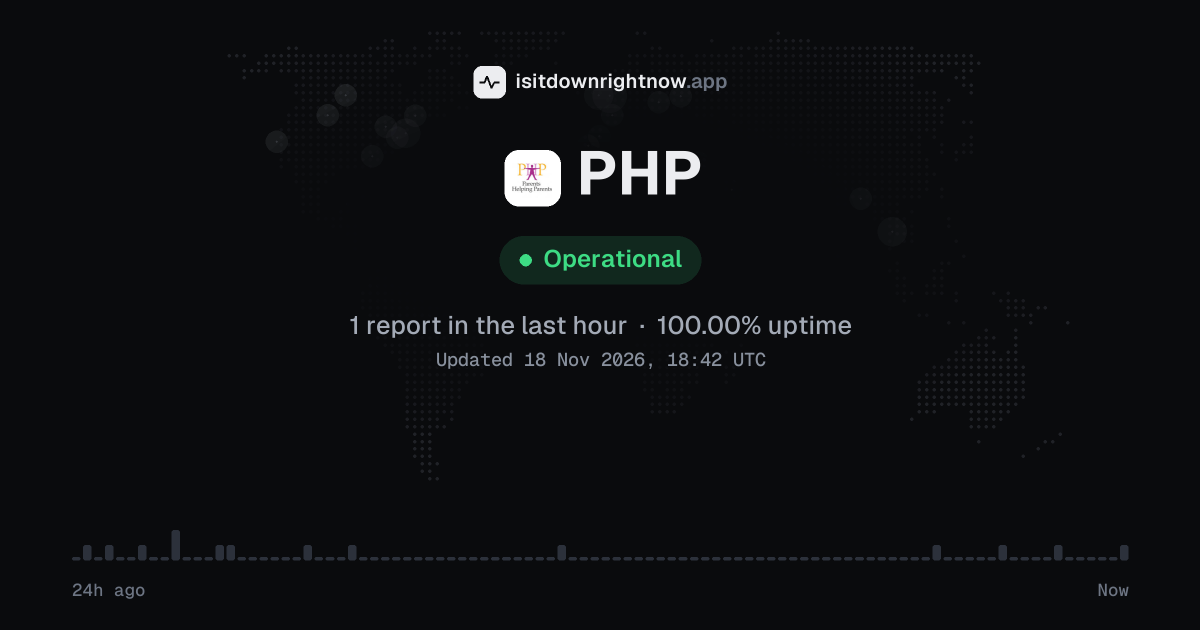
In the past 24 hours, 3 user reports came in for PHP. Counting only the 15-minute windows with a spike big enough to count as an outage, that comes to 100.00% uptime for the day.
The busiest 15-minute window had 1 report, about 11 hours ago. That stays below our outage threshold, so it doesn't count as downtime.
PHP in November 2026
- Problem reports in November
- 117
Monthly report for November 2026
People who report a problem with PHP to the outage-report feed behind this page can tag what is affected. These are the categories they can pick; the feed shows no counts per category:
- Website
- Server Connection
- Downloads and updates
PHP reports around the world
In the last 24 hours, 7 problem reports about PHP came in from 4 countries. Right now reports are at the usual level in every country.
- Outage now
- Problems now
- Normal
| Country | Now | Last hour | 24 hours |
|---|---|---|---|
| Canada | Normal | 1 | 1 |
| The US numbers above | Normal | 0 | 4 |
| India | Normal | 0 | 1 |
| Romania | Normal | 0 | 1 |
| Belgium | Normal | 0 | 0 |
| The Netherlands | Normal | 0 | 0 |
| New Zealand | Normal | 0 | 0 |
| The UK | Normal | 0 | 0 |
| South Africa | Normal | 0 | 0 |
| Australia | Normal | 0 | 0 |
| Denmark | Normal | 0 | 0 |
| Finland | Normal | 0 | 0 |
Each country's status compares its reports with the usual level there. 60 more countries had 0 reports in the last 24 hours. Map outlines: Natural Earth.
PHP problem spikes, last 30 days
Since 23 October, PHP had no outage spikes or periods of elevated reports.
- Sun 18 Oct: no data
- Mon 19 Oct: no data
- Tue 20 Oct: no data
- Wed 21 Oct: no data
- Thu 22 Oct: no data
- Fri 23 Oct: 2 reports
- Sat 24 Oct: 0 reports
- Sun 25 Oct: 0 reports
- Mon 26 Oct: 0 reports
- Tue 27 Oct: 0 reports
- Wed 28 Oct: 9 reports
- Thu 29 Oct: 17 reports
- Fri 30 Oct: 10 reports
- Sat 31 Oct: 7 reports
- Sun 1 Nov: 6 reports
- Mon 2 Nov: 13 reports
- Tue 3 Nov: 10 reports
- Wed 4 Nov: 6 reports
- Thu 5 Nov: 12 reports
- Fri 6 Nov: 10 reports
- Sat 7 Nov: 7 reports
- Sun 8 Nov: 6 reports
- Mon 9 Nov: 8 reports
- Tue 10 Nov: 6 reports
- Wed 11 Nov: 5 reports
- Thu 12 Nov: 7 reports
- Fri 13 Nov: 10 reports
- Sat 14 Nov: 7 reports
- Sun 15 Nov: 3 reports
- Mon 16 Nov: 1 report
By country
In the last 20 days, most PHP problem reports came from the US (159), the Netherlands (23) and Canada (13). None of these countries had a day at outage level.
- The USNo spikes159
- The NetherlandsNo spikes23
- CanadaNo spikes13
- BrazilNo spikes12
- FranceNo spikes9
- BelgiumNo spikes8
- ItalyNo spikes8
- The UKNo spikes7
- Outage spike
- Elevated reports
- Normal
- No data yet
Each square is one day. It turns red when reports stayed at outage level for half an hour or more, and amber when they stayed above the usual level for an hour or more. The number on the right is the country's total since 28 October 2026, when country history starts. A wider gap marks a Monday. Point at a square, or tap it, for that day's numbers. Days run from midnight to midnight, Central European time.
A spike is a sharp rise in problem reports from users, kept exactly as this page showed it at the time. This history starts on 23 October 2026. Monthly reports for all services
How to fix PHP not working
PHP is up on our end, so if it won't work for you, the problem is most likely on your side. Work through these in order:
Your browser tries to reach php.net over your own connection, right now. Nothing is sent to us or stored.
Run php -l on the file
Open a terminal in the project folder and run `php -l path/to/file.php`; the command reports syntax errors without executing the script. Fix the reported line, then run the check again.
Turn on display_errors for a test file
Add `ini_set('display_errors', '1'); error_reporting(E_ALL);` at the top of a temporary PHP file and load it in the browser. Delete the file after you check the output. If the page stays blank, read the web server error log because display settings may not reach output.
Compare CLI and web PHP
Run `php -v` and `php -m` in the terminal, then compare the version and loaded extensions with a `phpinfo()` page served by the web server. Use the same binary for both. If they differ, update the web server config to load the matching version and extensions.
Run the PHP built-in server
From the project root, run `php -S localhost:8000` and open that address in your browser. That isolates the code. If the page works there but fails through Apache or Nginx, check the web server config before you change the PHP code.
While PHP is down: what to use instead
- DevDocs When the manual pages will not load, this docs mirror keeps the function reference and examples for PHP close at hand.
- Stack Overflow Stack Overflow helps when an error blocks you.
- GitHub For source files and issue threads, many projects in the ecosystem keep copies there, so you can read or fetch them without the main site.
- Offline manual If you saved the manual or installed its package before, open it to check signatures and examples with no network connection.
When people report PHP problems
The busiest hour for reports about PHP is 19:00 to 20:00 Central European time, and the busiest day is Thursday.
By hour of the day
- 00:00 to 01:00: 0.23 reports on an average day
- 01:00 to 02:00: 0.36 reports on an average day
- 02:00 to 03:00: 0.2 reports on an average day
- 03:00 to 04:00: 0 reports on an average day
- 04:00 to 05:00: 0 reports on an average day
- 05:00 to 06:00: 0.03 reports on an average day
- 06:00 to 07:00: 0 reports on an average day
- 07:00 to 08:00: 0.03 reports on an average day
- 08:00 to 09:00: 0 reports on an average day
- 09:00 to 10:00: 0.03 reports on an average day
- 10:00 to 11:00: 0.03 reports on an average day
- 11:00 to 12:00: 0.02 reports on an average day
- 12:00 to 13:00: 0.01 reports on an average day
- 13:00 to 14:00: 0.08 reports on an average day
- 14:00 to 15:00: 0.38 reports on an average day
- 15:00 to 16:00: 0.14 reports on an average day
- 16:00 to 17:00: 0.19 reports on an average day
- 17:00 to 18:00: 0.28 reports on an average day
- 18:00 to 19:00: 0.23 reports on an average day
- 19:00 to 20:00: 0.55 reports on an average day
- 20:00 to 21:00: 0.28 reports on an average day
- 21:00 to 22:00: 0.32 reports on an average day
- 22:00 to 23:00: 0.34 reports on an average day
- 23:00 to 00:00: 0.38 reports on an average day
By day of the week
- Monday: 4 reports on an average Monday
- Tuesday: 2.7 reports on an average Tuesday
- Wednesday: 4 reports on an average Wednesday
- Thursday: 7.1 reports on an average Thursday
- Friday: 5.3 reports on an average Friday
- Saturday: 3.5 reports on an average Saturday
- Sunday: 2.5 reports on an average Sunday
Each bar is the average number of user reports in that hour, or on that day of the week, from 40 days of reports since 5 October 2026. The busiest bar is highlighted. Spikes in reports are left out, so one outage does not set the pattern.
What happens when PHP goes down
PHP is a server-side scripting language that powers a large share of the web; developers and site owners rely on it for WordPress, Laravel, Drupal and similar stacks. When the runtime or a host's setup fails, pages that depend on it stop rendering, which interrupts logins, form submissions, admin screens and content updates.
During an outage, blank pages and fatal error text show up before anything else because the request dies before your application code runs. Logins fail next. Form submissions hang or vanish, and API endpoints that rely on the runtime return gateway errors. The trouble is often partial or regional: a single host or a single PHP version can break while other sites on the same codebase keep serving pages; shared hosting and managed WordPress accounts feel it first because a full worker pool takes every site on that box down with it.
PHP IP address, servers and network
- IPv4 address
- 107.150.176.1
- IPv6
- 2400:52e0:1e00:2::1328:1
- Network
- AS200325 · BunnyCDN - BUNNYWAY, informacijske storitve d.o.o., registered in SI
- Served through
- bunny.net
- DNS hosted by
- its own name servers (easydns.net)
- HTTPS certificate
- Issued by Let's Encrypt, valid until 17 Jan 2027 (62 days)
- HTTP/3
- Not advertised
- Our check
- Answered in 313 ms
Checked from our server in Frankfurt, Germany, 22 h ago, for www.php.net. A service behind a CDN answers from many data centres, usually the one nearest to you, so these addresses are where its traffic enters, not where its own servers stand. Visitors elsewhere may see different addresses.
Checked from 12 places around the world
All 12 locations got an answer from www.php.net. Fastest from Milan (10 ms), slowest from São Paulo (249 ms). The answers came through 4 networks: Datacamp Limited (AS212238), Datacamp Limited (AS60068), OVH SAS (AS16276) and BunnyCDN - BUNNYWAY, informacijske storitve d.o.o. (AS200325).
| Location | Result | Time | Address reached |
|---|---|---|---|
| FrankfurtGermany | Up | 17 ms | 185.111.111.154Datacamp Limited |
| ViennaAustria | Up | 33 ms | 185.24.11.22Datacamp Limited |
| MilanItaly | Up | 10 ms | 84.17.59.117Datacamp Limited |
| ParisFrance | Up | 26 ms | 79.127.134.228Datacamp Limited |
| AmsterdamNetherlands | Up | 18 ms | 84.17.46.53Datacamp Limited |
| MadridSpain | Up | 43 ms | 37.19.215.33Datacamp Limited |
| WarsawPoland | Up | 11 ms | 57.128.232.80OVH SAS |
| DallasUSA | Up | 20 ms | 212.102.40.113Datacamp Limited |
| Los AngelesUSA | Up | 21 ms | 138.199.9.104Datacamp Limited |
| São PauloBrazil | Up | 249 ms | 193.162.131.16BunnyCDN - BUNNYWAY, informacijske storitve d.o.o. |
| SingaporeSingapore | Up | 16 ms | 84.17.38.250Datacamp Limited |
| TokyoJapan | Up | 18 ms | 109.61.83.99Datacamp Limited |
Checked with check-host.net from its servers in these cities 22 h ago, for www.php.net. Time is how long each server took to load the page.
PHP FAQ
Is PHP down right now?
Why does my PHP script show a blank page instead of an error?
Why does a long PHP request stop with a maximum execution time error?
Why does Composer say my requirements cannot be resolved for a PHP package?
Why does PHP send a headers already sent warning when I redirect?
Contact PHP support
Tip: PHP doesn't list a public status page that we know of, so its help centre and the report chart on this page are the best places to check.
Put the PHP status on your site
Paste one of these into a web page, a blog post or a README: a small badge, or a card with the chart. Both show the same status as this page, based on user problem reports, and link back here.

<a href="https://isitdownrightnow.app/services/php/"><img src="https://isitdownrightnow.app/badge/php.svg" alt="PHP status" height="20"></a>[](https://isitdownrightnow.app/services/php/)A live card with the chart
The status, reports in the last hour and the last 24 hours, updated every 5 minutes. Use the frame, or the image where frames are not allowed, such as newsletters.
<iframe src="https://isitdownrightnow.app/embed/php/" title="PHP status" width="100%" height="230" style="border:0;max-width:560px" loading="lazy"></iframe>
<p><a href="https://isitdownrightnow.app/services/php/">PHP status</a> from IsItDownRightNow.app</p><a href="https://isitdownrightnow.app/services/php/"><img src="https://isitdownrightnow.app/share/php.png" alt="PHP status: problem reports over the last 24 hours" width="600" height="315" loading="lazy"></a>[](https://isitdownrightnow.app/services/php/)Badge, frame and image load no scripts from other sites and set no cookies; people who see them on your page load them from our server. More for journalists.
How we track PHP
The status on this page comes from user-submitted problem reports for PHP, counted in 15-minute windows over the last 24 hours. Each window is compared with the normal level for PHP, so a few complaints on a quiet day don't trigger anything, but a sudden jump well above normal does.
When reports climb well above normal, the status here changes to partial outage or major outage and the chart moves with it. PHP doesn't publish a public status page that we know of, so user reports are often the quickest sign that something is wrong on their side.