OutageMonday 23 November 2026Ended 23:46
Tinder outage on 23 November 2026
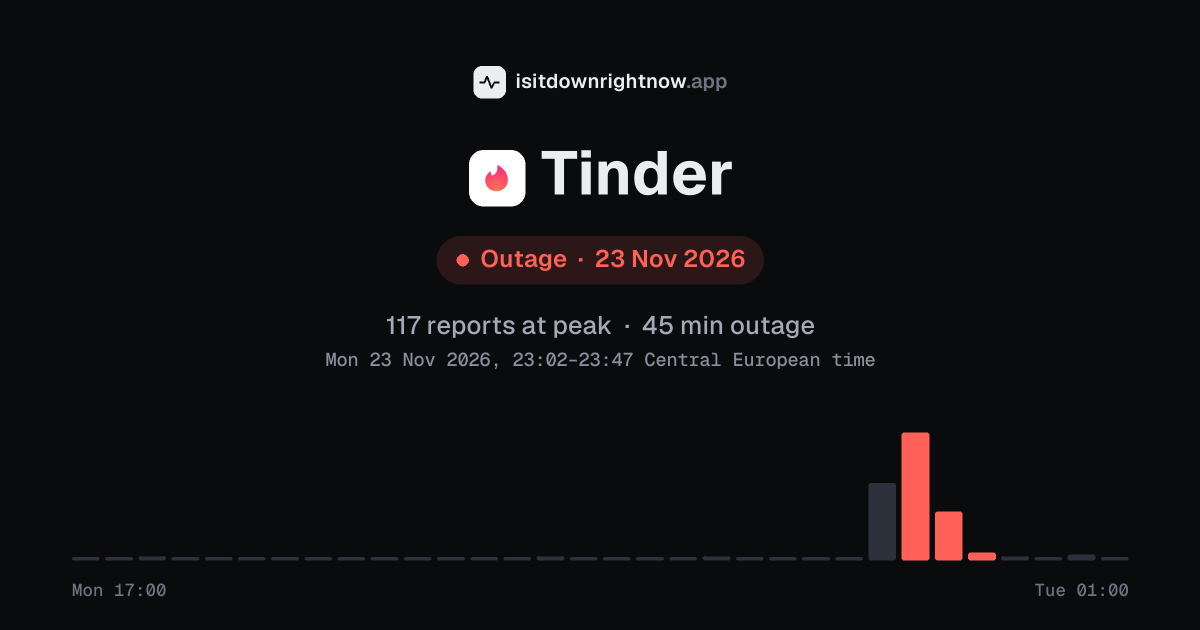
Problem reports about Tinder rose to outage level at 23:01 Central European time on Monday 23 November 2026 and stayed there for 45 min.
They peaked at 117 reports in 15 minutes at 23:12, about 117 times the usual level for that time of day, and 104 reports came in while the outage lasted.
No single country reached outage level for half an hour; the reports were spread out.
12 other services had an outage spike at the same time.
Reports from Mon 17:00 to Tue 00:45
One bar per 15 minutes, Central European time. Red bars are the outage; the dashed line is what a usual day sees at that time.
Where people reported it that day
Each country's reports on 23 November, against the usual level there. Outage means reports stayed at outage level for half an hour or more; above usual, for an hour or more.
| Country | That day | Reports |
|---|---|---|
| Saudi Arabia | Normal | 9 |
| The US | Normal | 5 |
| Canada | Normal | 1 |
| The UK | Normal | 1 |
Other services with an outage at the same time
Their reports also reached outage level while Tinder's did. Many services failing together can point to a shared cause, such as a network or cloud provider, but reports alone cannot show it.
- Outage
18:31–Tue 00:461,749peak reports
- Outage
22:01–Tue 00:46733peak reports
- Outage
13:46–23:46441peak reports
- Outage
10:16–Tue 00:46374peak reports
- Outage
23:16–Tue 00:16287peak reports
- Outage
17:46–Tue 00:46282peak reports
- Outage
20:01–Tue 00:46238peak reports
- Outage
11:46–Tue 00:46192peak reports
- Outage
12:01–Tue 00:46191peak reports
- Outage
09:16–Tue 00:46169peak reports
- Outage
22:01–Tue 00:31141peak reports
- Outage
22:01–Tue 00:01131peak reports
Tinder: live status and other outages
Check whether Tinder is down right now: the live page shows the last 24 hours and fixes to try. This site keeps a page for each of Tinder's 2 outages since the archive began.
Earlier: 15 Nov 2026 November 2026 outage report All recent outages
Put this outage in an article
Copy a frame with the chart and numbers above, or an image of the same card for places that do not allow frames, such as newsletters. Both link back to this page. More for journalists.
<iframe src="https://isitdownrightnow.app/embed/tinder/2026-11-23/" title="Tinder outage on 23 November 2026" width="100%" height="230" style="border:0;max-width:560px" loading="lazy"></iframe>
<p><a href="https://isitdownrightnow.app/services/tinder/outages/2026-11-23/">Tinder outage on 23 November 2026</a> from IsItDownRightNow.app</p>
Frame: the chart and numbers, as a small card<a href="https://isitdownrightnow.app/services/tinder/outages/2026-11-23/"><img src="https://isitdownrightnow.app/share/tinder/2026-11-23.png" alt="Tinder outage on 23 November 2026: problem reports over time" width="600" height="315" loading="lazy"></a>Image: the same card as a picture[](https://isitdownrightnow.app/services/tinder/outages/2026-11-23/)Markdown: the image, for README files and forumsWhere these numbers come from
The numbers are problem reports that users sent to a public outage-reporting service, counted in 15-minute windows and kept as this site's live page showed them. A spike counts as an outage when reports are more than twice the usual level and far above the day's average. Reports show that many people had trouble at the same time, not what caused it; the service's own status page is the place for that.