OutageWednesday 4 November 2026Ended 04:56
EE outage on 4 November 2026
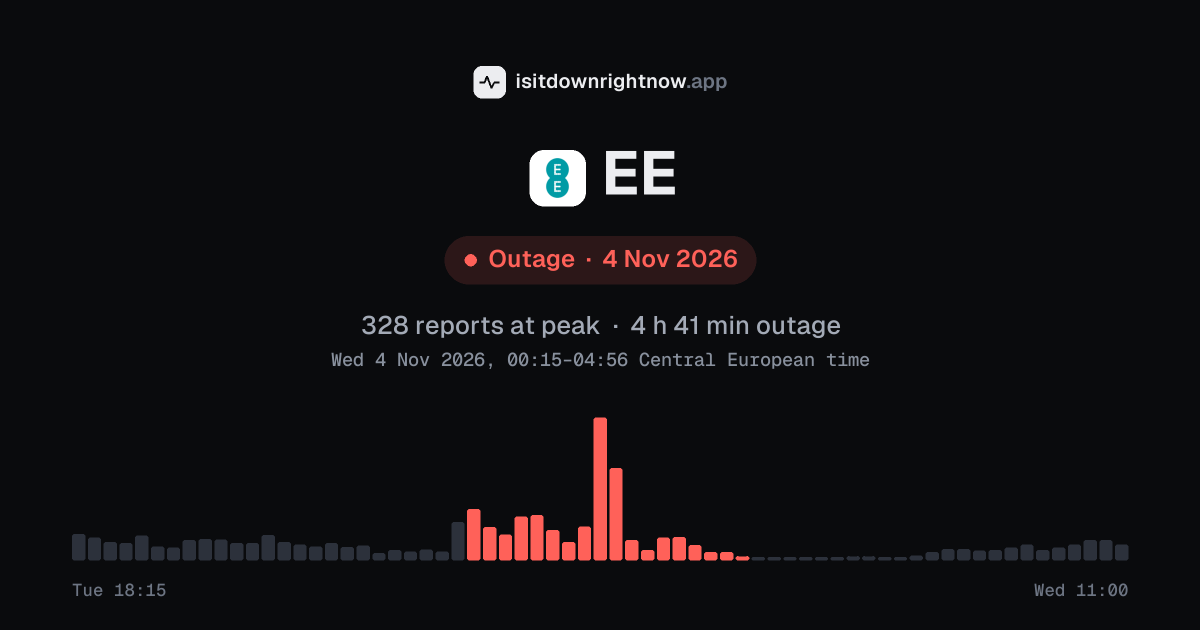
Problem reports about EE rose to outage level at 00:15 Central European time on Wednesday 4 November 2026 and stayed there for 4 h 41 min.
They peaked at 328 reports in 15 minutes at 02:31, about 55 times the usual level for that time of day, and 1,002 reports came in while the outage lasted.
12 other services had an outage spike at the same time.
Reports from Tue 18:15 to Wed 11:00
One bar per 15 minutes, Central European time. Red bars are the outage; the dashed line is what a usual day sees at that time.
Other services with an outage at the same time
Their reports also reached outage level while EE's did. Many services failing together can point to a shared cause, such as a network or cloud provider, but reports alone cannot show it.
- Outage
Tue 16:21–05:193,912peak reports
- Outage
Tue 23:47–01:003,613peak reports
- Outage
Tue 23:36–04:321,212peak reports
- Outage
01:00–01:561,011peak reports
- Outage
00:10–01:53695peak reports
- Outage
Tue 08:52–06:46571peak reports
- Outage
02:18–04:47407peak reports
- Outage
01:28–03:29396peak reports
- Outage
Tue 23:59–02:36353peak reports
- Outage
04:43–07:00258peak reports
- Outage
04:15–05:04245peak reports
- Outage
03:14–08:40242peak reports
EE: live status and other outages
Check whether EE is down right now: the live page shows the last 24 hours and fixes to try. This site keeps a page for each of EE's 5 outages since the archive began.
Earlier: 3 Nov 2026 Later: 5 Nov 2026 November 2026 outage report All recent outages
Put this outage in an article
Copy a frame with the chart and numbers above, or an image of the same card for places that do not allow frames, such as newsletters. Both link back to this page. More for journalists.
<iframe src="https://isitdownrightnow.app/embed/ee-everything-everywhere/2026-11-04/" title="EE outage on 4 November 2026" width="100%" height="230" style="border:0;max-width:560px" loading="lazy"></iframe>
<p><a href="https://isitdownrightnow.app/services/ee-everything-everywhere/outages/2026-11-04/">EE outage on 4 November 2026</a> from IsItDownRightNow.app</p>
Frame: the chart and numbers, as a small card<a href="https://isitdownrightnow.app/services/ee-everything-everywhere/outages/2026-11-04/"><img src="https://isitdownrightnow.app/share/ee-everything-everywhere/2026-11-04.png" alt="EE outage on 4 November 2026: problem reports over time" width="600" height="315" loading="lazy"></a>Image: the same card as a picture[](https://isitdownrightnow.app/services/ee-everything-everywhere/outages/2026-11-04/)Markdown: the image, for README files and forumsWhere these numbers come from
The numbers are problem reports that users sent to a public outage-reporting service, counted in 15-minute windows and kept as this site's live page showed them. A spike counts as an outage when reports are more than twice the usual level and far above the day's average. Reports show that many people had trouble at the same time, not what caused it; the service's own status page is the place for that.